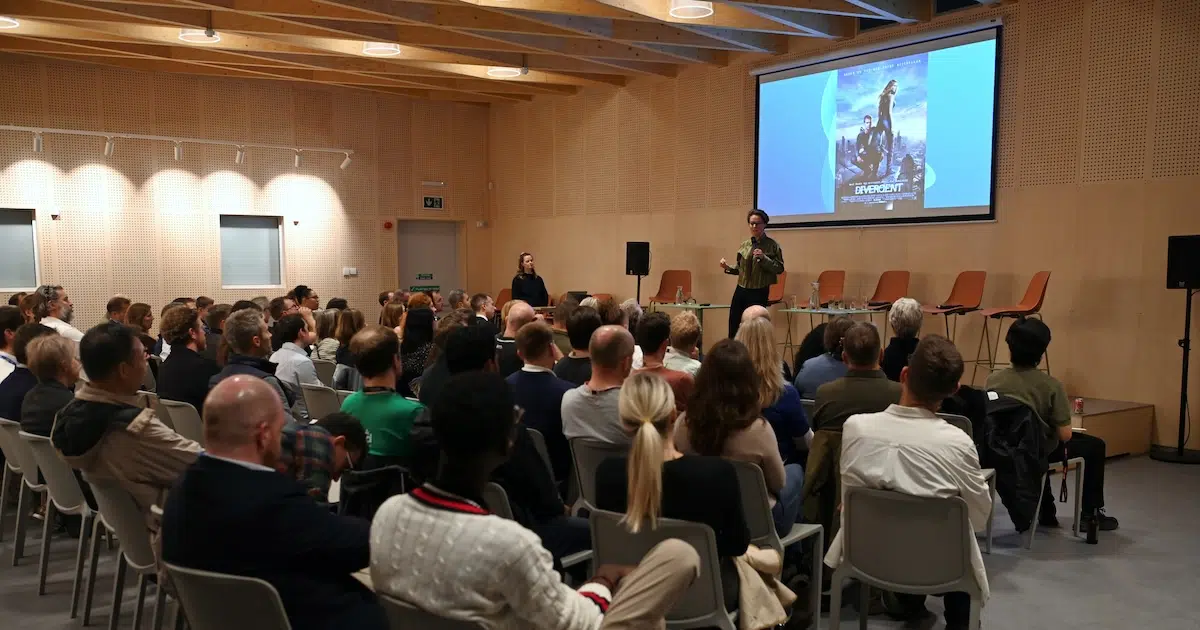
As Plexal’s CEO Saj Huq and Director of National Security and Defence, Tom Jeffery, attend the Atlantic Future Forum in Oslo this week, we discuss the urgent need for building capability at speed and what steps are required to get there.
The Atlantic alliance between North America and Europe has a powerful foundation for defence transformation: strong innovation systems, healthy capital markets and a growing community committed to national security.
The opportunity we have in front of us is to turn that collective strength into technology that operational users can adopt and use.
And at the Atlantic Future Forum (AFF26) in Oslo aboard HMS Prince of Wales – the eighth international summit for defence, security and technology leaders – Driving Transformation and Accelerating Adaptation is a key theme. Behind that ambition sits a practical challenge: how can defence and national security organisations identify, adopt and scale relevant technologies quickly enough to meet changing operational needs?
Start with the problem, not a prescribed solution
It’s well known that slow procurement and legacy processes can stand in the way. Tightly prescribed requirements can also overlook existing dual-use technologies: solutions with both civilian and defence or security applications. While commercial investment and demand drive these technologies forward, defence and national security customers risk missing out.
Modernising procurement is part of the answer but we can’t overlook the route to getting there. Organisations need to identify operational needs, assess relevant technologies and support implementation. Finding a promising solution is only the beginning.
Plexal’s experience points to an approach that starts with an operational problem rather than a fixed list of requirements. This method can open the door to companies not typically incentivised to work in defence or national security, including providers whose existing products might be excluded by a narrow brief.
LASR illustrates this preparation for adoption: it brings together Plexal, government, academia and industry to advance UK leadership in AI security research, giving startups access to technical experts and end-users to help align their technologies with real-world needs.
Connect technology with the people who need it
A problem-led approach brings government together with people who can help. The Accelerated Capability Environment (ACE) helps public sector teams tackle urgent challenges through a partnership between government and the private sector. This brings in small businesses, larger suppliers and academics to develop and test solutions with the people who will use them, often within 12 weeks, with independent checks on delivery.
The work of ACE includes using AI to spot suspicious items in freight-vehicle X-ray scans, improving accuracy and saving Border Force time. A separate pilot explored how to identify and respond to deepfakes on social media ahead of elections. These examples show how ACE connects expertise with practical needs, from border security to protecting democracy, while recognising that testing an idea isn’t the same as proving its impact.
The alliance’s innovation strength creates an opportunity. Turning it into national and allied advantage depends on a more responsive adoption system, connecting the technology market with operational needs.
By getting relevant capabilities into users’ hands at pace, defence and national security organisations can strengthen their ability to counter adversaries. The potential is there and the task is to make the route from innovation to use work.