No single organisation, industry or country can build an AI future alone. At Plexal’s AI Sovereignty in the Era of Strategic Competition event – part of CyNam’s Gloucestershire Tech Week – leaders from technology, national security, research and industry explored how collaboration, resilience and responsible adoption will shape the UK’s long-term AI advantage.
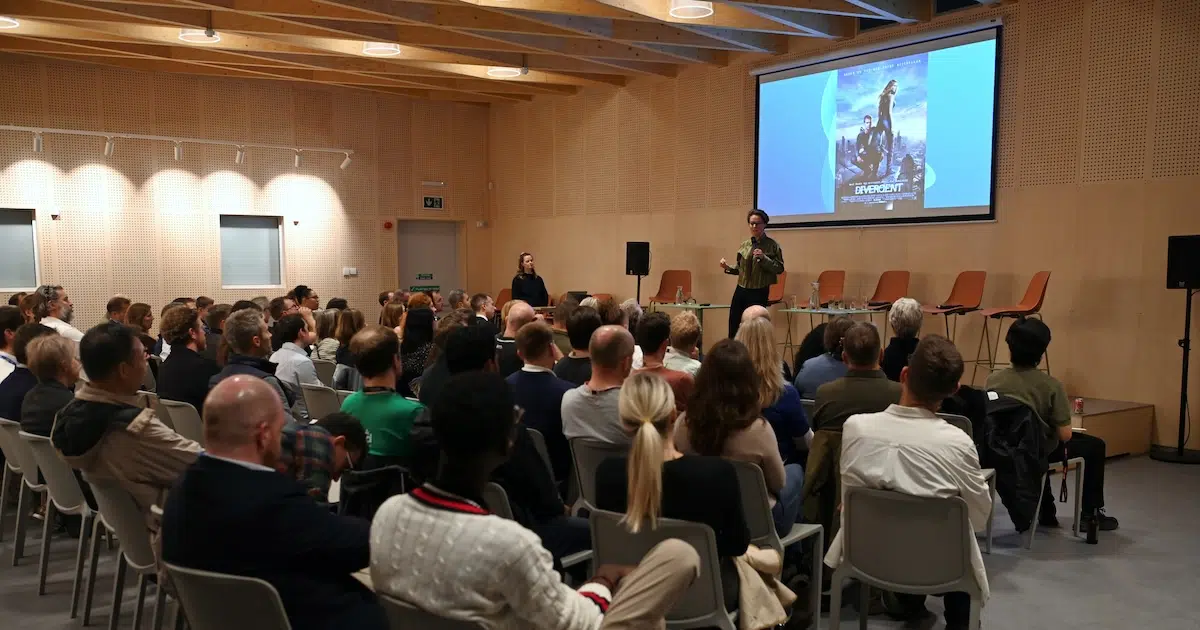
Which Hollywood film would you compare to the current AI landscape?
That’s the opening question posed to the panel of speakers Plexal convened from the worlds of technology, national security, research and industry for the AI Sovereignty in the Era of Strategic Competition event at our Cheltenham base, the Hub8 MX.
It’s fitting really. AI is rapidly reshaping economies, industries and societies around the world in ways that wouldn’t look out of place on a movie script.
Given the breadth of panellists we were joined by, the answers were extremely varied – but you may be surprised to hear nobody mentioned I, Robot or A.I. Artificial Intelligence.
Instead, we heard AI likened to Gladiator as powerful actors try to dictate direction and outcomes, while The Big Short was also a consideration with value attributed to AI expected to take years to materialise as adoption challenges persist.
Elsewhere there was talk of Star Trek: The Motion Picture for the prospect of intelligence evolving beyond its intended purpose, whereas The Muppet Christmas Carol also made it on the list – with a need to heed the ghosts of technologies past to enact change that can secure AI’s positive future.
As AI capabilities accelerate, questions of sovereignty, resilience and strategic advantage are becoming increasingly important. Countries are now asking what it’ll take to develop, deploy and benefit from AI while maintaining long-term competitiveness in an AI-driven world.
From access to talent, compute and investment, to trusted supply chains, adoption and innovation, AI is becoming a strategic capability that will shape economic prosperity, national resilience and global influence for decades to come.
Our event took place as part of CyNam’s Gloucestershire Tech Week but this discussion, like AI itself, is evolving at pace.
Ahead of tomorrow’s Budget, Chancellor John Healey has just declared: “AI is the defining technology of our generation – helping solve people’s health problems, keeping Britain safe, and supporting British AI firms to grow and scale. The same technologies that can drive growth and innovation can also be exploited by hostile actors, creating new risks for cyber security, critical infrastructure and public safety.”
Responding with “our most ambitious AI package to date”, the Chancellor committed £120m for the AI Security Institute, £165m for a National AI Biosecurity Initiative and collaboration with OpenAI and Anthropic to expand access to advanced AI models. These commitments demonstrate how questions of sovereignty, resilience and strategic advantage are increasingly shaping both policy and investment decisions.
Here’s how the rest of our discussion unfolded.
AI sovereignty is about more than AI
The cornerstone of our panel was that AI sovereignty can’t be reduced to ownership of models alone.
Public debate often focuses on AI models and breakthrough capabilities, however our panel repeatedly returned to the wider ecosystem required to support long-term competitiveness. Talent, compute, energy, investment, data, supply chains and adoption were all highlighted as critical components of national capability.
There was broad agreement that the UK possesses significant strengths, particularly in research, innovation and entrepreneurship. However, our speakers also noted persistent challenges around scaling businesses and retaining the intellectual property, investment and talent generated by the country’s startup ecosystem.
Rather than chasing complete independence, the conversation suggested the UK’s opportunity lies in identifying areas of strategic strength and building resilience across the wider AI ecosystem.
Adoption must be matched with trust
Organisations are racing to capitalise on AI, but it was said there’s a need to balance innovation with governance.
The discussion highlighted an array of approaches – organisations attempting to restrict AI use altogether to those encouraging adoption without sufficient oversight. Ultimately, neither was considered sustainable.
This is where the conversation centred on the importance of trust. Questions around where data is stored, who can access it and how AI systems make decisions are becoming increasingly important for organisations operating in regulated or critical environments.
This challenge is thought to extend beyond technology itself. Successful adoption depends on establishing confidence among employees, leaders, customers and regulators alike.
The takeaway was that long-term value will be realised not by adopting AI the fastest, but by adopting it responsibly.

The future of AI will be shaped by people
With Cheltenham and Gloucestershire renowned for cyber, technology and national security expertise, people were championed as the lynchpin.
Whether discussing skills, investment, innovation or national resilience, the conversation repeatedly returned to the importance of talent – the people developing, deploying and governing the technology.
That includes future generations.
The panel was acutely aware that young people need to be in the room – and we’re happy that some were for our session. But it was noted how educators, employers and policymakers can help ensure young people are equipped not only to use AI tools, but to understand the opportunities and implications they present.
TechFirst for schools is one such government-backed initiative that’s taking steps to ensure this is the case, declaring it’s “helping young people gain practical skills, get confident with AI and explore future careers in tech”.
And despite valid worries and concerns often being discussed, our event attendees were also encouraged not to view AI through a lens of fear, but as something to engage, experiment with and shape.
Bringing the right voices together
While perspectives differed throughout the evening, there was broad agreement on one point – that no organisation, sector or country can solve these challenges alone. Not one.
Questions of sovereignty, resilience and competitiveness sit at the intersection of government, industry, academia, investors and innovators. Then building effective responses requires collaboration between all of them.
Crucially, maintaining diverse perspectives around the table will be essential to ensuring AI reflects the interests and values of the society it serves.
This rundown demonstrates why conversations like this are essential.
AI Sovereignty in the Era of Strategic Competition provided an opportunity to challenge assumptions, share experiences and explore how the UK can build lasting advantage in an increasingly AI-driven world.
Although some of the reports surfacing about AI each day may read like a Hollywood screenplay, shaping our future depends on decisions being made today.

