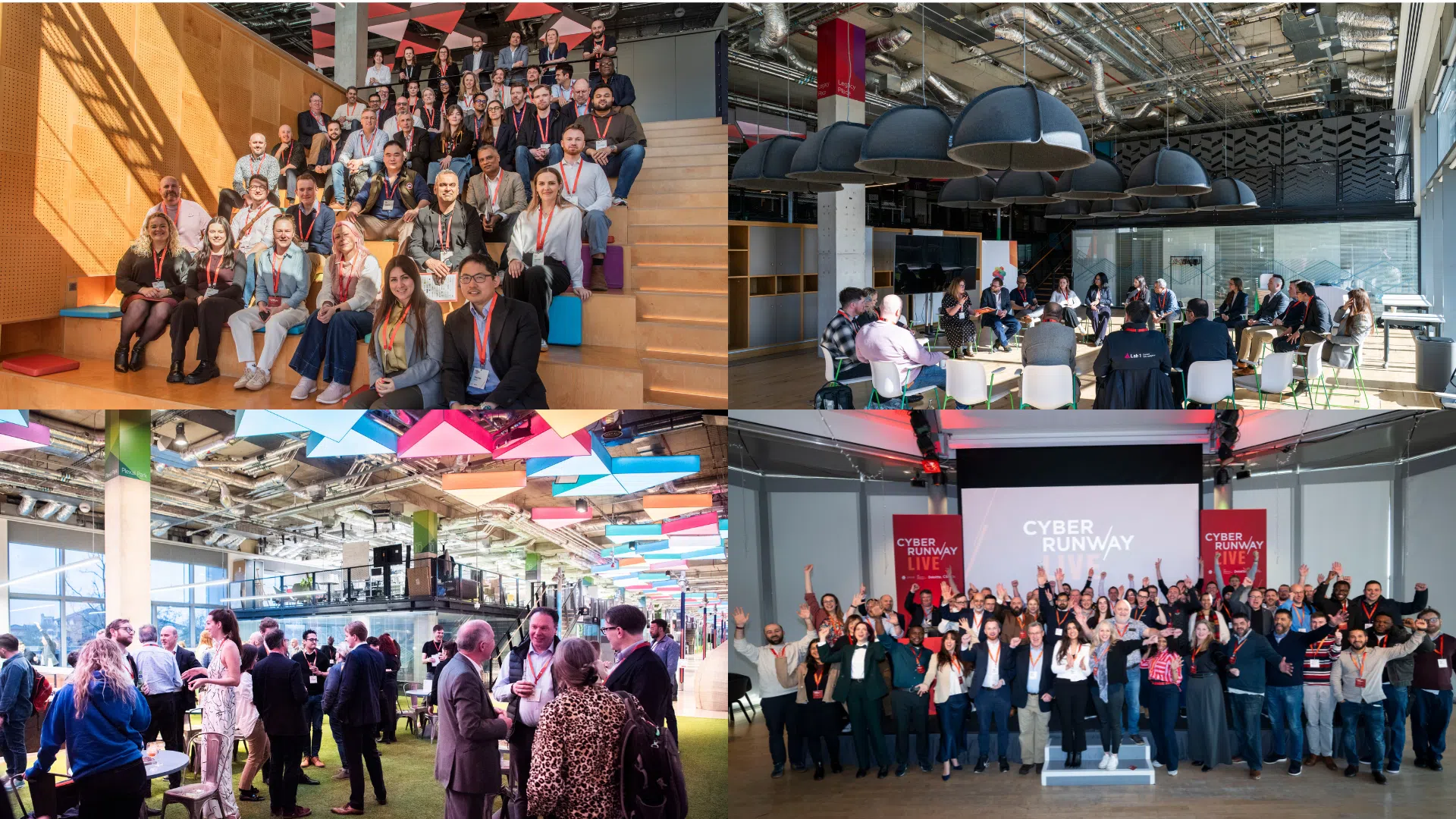
To close the fifth Cyber Runway, the largest cyber accelerator in the UK, we assembled our latest programme participants and those from our alumni community for Cyber Runway Live – an in-person celebration of their efforts to innovate, grow and make the UK more secure from digital threats.
The five cohorts included:
Having delivered the programme on behalf of the Department for Science, Innovation and Technology (DSIT), Cyber Runway Live took place at Plexal HQ in Stratford on the Here East campus.

On the day, James Stanley, Head of Sectoral Engagement at DSIT, said: “Cyber Runway introduced me to so many great companies, reinforcing why we should be proud of the UK cyber sector – one of the strongest in the world.”
That statement is backed up with the Tuesday 12th May release of this year’s cyber security sectoral analysis from DSIT. It reveals the cyber sector has generated £14.7bn in revenue and employs almost 70,000 people – with 2,300 jobs created in the past year alone – across over 2,600 firms.
Simultaneously, the government released the Cyber Resilience Pledge. This new enterprise engagement initiative arrived to encourage UK companies to strengthen their security efforts as AI-enabled threats evolve at speed. The pledge comprises three key areas for businesses:
(1) Cyber security becomes a board-level responsibility.
(2) Registration to the National Cyber Security Centre’s free Early Warning Service.
(3) Cyber Essentials certification – the UK government-backed cyber security standard that blocks the most common cyber threats – across their supply chains.
Alongside this new cyber campaign from government, Plexal welcomed Baroness Lloyd, Minister for the Digital Economy and Cyber Security, to our HQ. Here, we convened trailblazing startup founders developing cyber and AI solutions to keep the UK secure for introductions. They included David Sully from Advai, Awais Rashid from Hacktonics, Lloyd Davies from Infrawatch – which has newly secured a $3m pre-seed investment to strengthen its cyber threat detection and online fraud prevention – Robin Brattel from Lab 1, Julia O’Toole from MyCena, George Dunlop from Quantum Dice and Melissa Chambers from Sitehop.

In the announcement, Baroness Lloyd said: “Cyber security is now fundamental to economic growth, job creation and the resilience of the services people rely on every day. The UK has a world‑class cyber sector that is creating skilled jobs and protecting our economy – and government is doing more by investing in its own defences, legislating to require more of essential services and setting clear national standards.
“As threats evolve, businesses of all sizes need to step up and take practical action now. The Cyber Resilience Pledge is a clear call for companies to strengthen their defences, protect their customers and play their part in keeping the UK secure and competitive.”
When introducing the cyber leaders from across our ecosystem to the minister, she heard stories about their respective growth journeys and successes including navigating scaling while being bootstrapped through to raising investment. Simultaneously, they shared challenges encountered on the entrepreneurial path and were able to offer ideas to make positive change.
Founders revealed the value of government-backed programmes. This included building a cross-sector peer network from government, security and investment through Cyber Runway, benefits of one-to-one introductions to generate new business and where they’ve contributed to AI security research and co-created products.

Saj Huq, CEO at Plexal, said: “Cyber security is a cornerstone of the UK’s digital economy. The companies we work with are not only building products and services for the private sector, but increasingly supporting government and national security priorities. Unlocking this opportunity requires careful cultivation of ecosystems, collaboration across sectors and the ability to bridge complex challenges with innovative solutions.
“Plexal was founded to ensure that the best ideas, talent and technologies reach the areas where they matter most for the UK’s economy and its security. In doing so, we aim to drive both growth and inclusivity across the country.”
When we reintroduced Cyber Runway in September, it was part of the Cyber Growth Action Plan. Our programme goal was to drive innovation, create high-quality jobs and secure long-term economic resilience, so we’re encouraged by the government’s continued efforts to keep pushing for progress with the new analysis figures and pledge.

“Our growth in cyber isn’t by accident,” James continued. “We have technical talent and innovators turning ideas into products into businesses to protect citizens and organisations from cyber attacks. And Cyber Runway exists to give the people within this ecosystem the support and mentorship needed to grow and scale.”
As new threats continued to materialise and develop, we evolved Cyber Runway with new focuses on net zero innovation and critical national infrastructure resilience. “In doing so, we connected our Cyber Runway innovators with real world challenges to make their impact felt,” James added.
The need to protect critical infrastructure is so significant, the Cyber Security and Resilience Bill includes laws to ensure essential services, such as energy and healthcare, and was addressed in the King’s Speech on Wednesday 13th May.
Through Cyber Runway CNI, Plexal worked to bridge the gap between cutting-edge UK cyber innovation of SMEs and the urgent security needs of critical sectors. And while Cyber Runway CNI has concluded, our work continues.
“Over the past decade, we’ve supported hundreds of companies, built strong partnerships with government and industry and helped shape ecosystems that address some of the UK’s most complex challenges,” Saj detailed. “We’ve had the privilege of working alongside founders throughout their journeys, supporting them through both successes and challenges and take great pride in seeing them scale in the UK and globally.”

Plexal is independently continuing the conversation linked to critical national infrastructure through our CISO Forum series of events. The CISO Forum was built to create a trusted, closed environment for senior security leaders to compare challenges, share practical insights and shape collective approaches to cyber resilience.
Our next CISO Forum, which comes to Infosecurity Europe on Thursday 4th June, will ask: what’s the impact of AI on critical national infrastructure? We’ll unpack that very question in a conversation chaired by Jo Miller, National Security Officer at Microsoft, so be sure to register to have your say.
We’re proud to have been at the forefront of cyber innovation in the UK since 2018, from delivery of LORCA and NCSC For Startups to Cyber Runway, DiSH and the Laboratory for AI Security Research. In doing so, our mission has been to close critical capability gaps to ensure national resilience and boost the UK economy. We welcome Baroness Lloyd and her peers back any time to see these innovative solutions at work.