“I have a close friend who has an automated ping sent to me when she enters a taxi and another when she leaves. I have friends whose everyday behaviours are guided by risk. They take different routes home, call each other while travelling and navigate fears of how their personal images might be used in ways they weren’t intended.”
This was the thought-provoking personal dialogue from Lou-Davina Stouffs, Plexal’s Director of Consulting, when she took to our Stratford HQ’s Centre Stage to open our Tech for Good: Ending Violence Against Women and Girls panel.
In her role, Lou helps clients better understand, adopt and experiment with emerging technologies and she explained ending violence against women and girls has become a huge UK priority.
It’s a major theme for the Home Office, resulting in many efforts to generate solutions funnelled through the Accelerated Capability Environment (ACE) co-delivered by Plexal and PA Consulting. Elsewhere, we’re supporting TfL to help address violence against women and girls on London’s bus network.
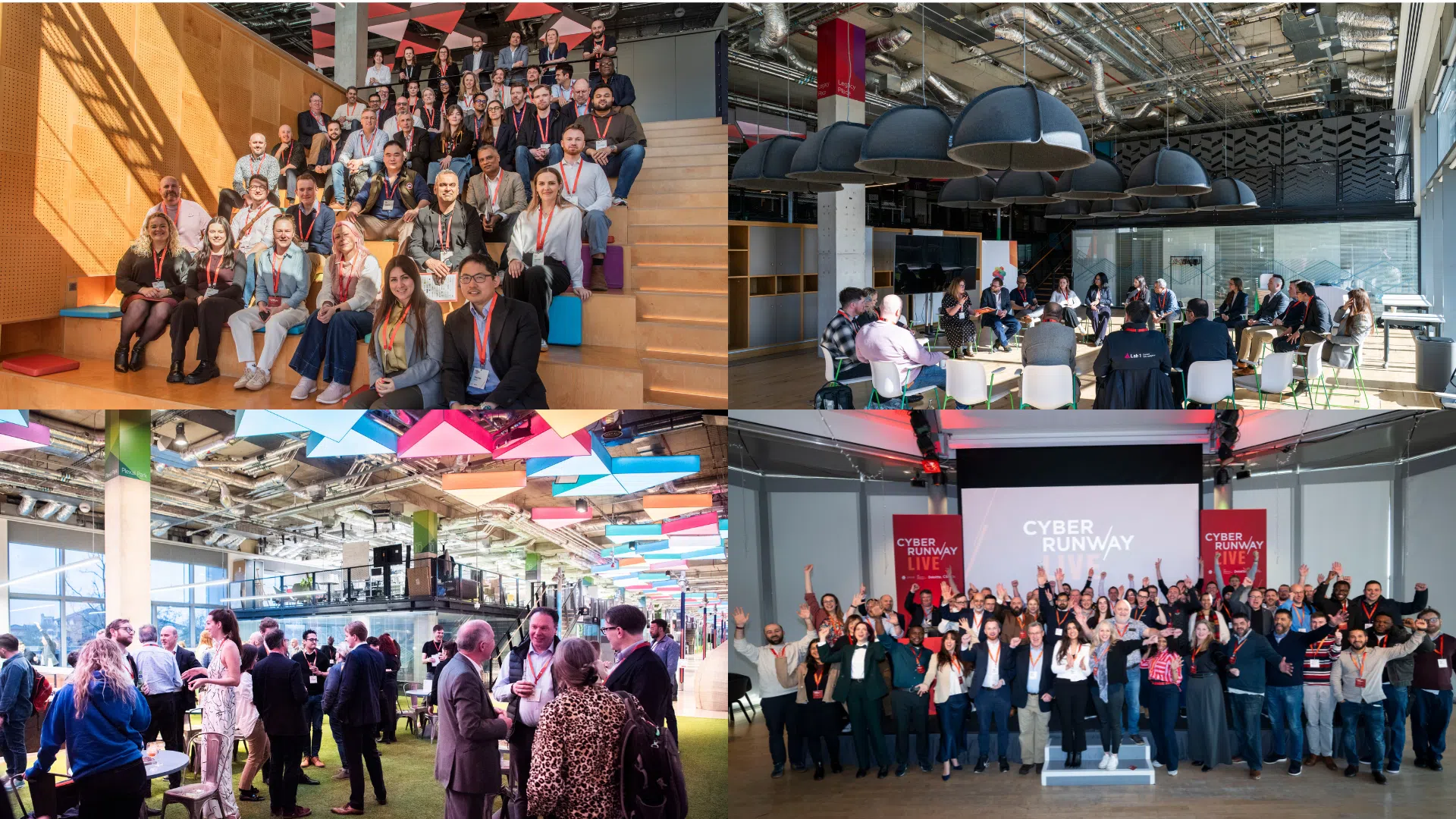
To mark the innovation and creativity festival SXSW London taking place last week, Here East, Plexal and LMA hosted the second It all starts Here event on Wednesday 3rd June 2026.
The Here East campus buzzed with an enthusiastic crowd of over 800 insight-hungry delegates that came to feast on tech-focused panel discussions and network over live music, innovation demos, food and drinks.

The Tech for Good: Ending Violence Against Women and Girls panel formed part of It all starts Here, with speakers including:
- Laura Suggitt from The Merrittocracy, the social justice agency changing systems to prevent harm.
- Eleanor Kaye from Augur, the AI resilience company protecting national security infrastructure and public spaces.
- Jamie Hodsdon from Waymo, the autonomous ride-hailing service.
The greatest moment we’ve had to end violence against women and girls
Violence against women and girls was declared a national emergency by the National Police Chiefs’ Council in 2024, as a National Policing Statement revealed 3,000 offences are recorded daily, with at least one in 12 women expected to be a victim each year.
Lou pointed to AI and data advances presenting new ways to understand patterns of harm, conceding technology can also amplify methods of abuse.
Given this, particularly the positioning of violence against women and girls as a national security challenge, Lou asked the panel how the threat should be responded to.
“With a whole of system response,” said Laura. “It’s everyone’s problem – the tech builders, regulators, government, policing, individuals and educators. It’s something we all need to get behind and tackle – we all have a role to play.”

She noted an issue facing violence against women and girls is resourcing – pointing to a funding shortfall estimated at £400m, compared to an ongoing flow of investment in other technologies more broadly.
“In terms of national security, technology has a massive role,” she continued. “The end of 2025 was the highest quarter for violence against women and girls’ offences worldwide, largely facilitated by new and emerging technologies, such as chatbots and deepfakes.
“As someone who’s worked [in this area] a long time, I think this is the greatest moment we’ve had to end violence against women and girls. Technology is proliferating harm, but this is an opportunity to use technology for good as a weapon in our arsenal.”
Lou turned to the role of the technology sector itself, asking Eleanor and Jamie what the industry is getting right – and where more progress is needed.

Keeping humans looped in
Eleanor explained Augur’s purpose revolves around keeping people safe as they go about their daily lives. “Augur exists to protect people where they travel, live, work and gather,” she said. “For us, it’s about making sure that as you move through society, you feel safe that technology can play a practical supporting role when it’s deployed responsibly.”
In practice, this involves transforming existing CCTV infrastructure into “sensor intelligence”, whereby AI can be applied to detect potential incidents in real time and alert operators on the ground to make decisions.
That means human judgement remains central.
“It’s really important for us that humans are kept in the loop – the AI isn’t autonomous,” Eleanor continued. “Operators decide what happens next and that feeds into post-incident investigations and, ultimately, convictions.”
She emphasised that the sector must be mindful of governance frameworks – including what data is collected to solve the issues on the ground – to remain compliant and achieve the desired impact.

Safety by design – of the vehicle and for the passenger
Having launched across 11 American cities such as Los Angeles and Orlando and with a $16bn investment round secured in February, Waymo is well equipped for scaling into London by the end of this year.
Sharing lessons from the US ahead of rollout in the UK capital, Jamie detailed: “Historically, what’s turned people off autonomous vehicles is a fixation on the technology in the car,” he said.
For Waymo, it’s about ensuring passengers are safe within the car but have a good customer experience in the process. “From a vehicle perspective, we’ve built a safety framework covering everything from collision avoidance to protecting vulnerable road users,” Jamie said. “But safety by design goes beyond the vehicle.”
One notable feature he highlighted that can help improve safety for women and girls when travelling is called minimise walking. The function allows customers to request the car comes directly to their location, whether that’s for better streetlighting, more bystanders or otherwise. “It might take a bit longer, but it helps people feel safer,” he said.
“There’s no driver in the vehicle, but through the app or in-car interface, riders can contact support directly. That person’s sole role is to help you as a customer if you feel unsafe or need assistance.”

The power of prevention
Laura took this moment to join the dots between Eleanor and Jamie’s insights.
“What’s coming through strongly is the importance of preventing harm before it happens,” she said. “It’s not just about helping people feel safe after the fact – it’s about using technology to reduce risk and ultimately stop harm from occurring.”
Lou built on this, turning the conversation towards the safety by design concept to ask how more organisations can embed these principles from the outset.
Standing firm, Laura asserted safety by design “has to be real” as opposed to a buzzword. “Every product that comes to market should go through a violence against women and girls risk assessment before it’s deployed,” she said. “In some cases, we’ve seen tools released at speed, with harms only addressed years later. That process needs to happen upfront as part of ethical governance and product design.”
Crucially, this shouldn’t happen in an isolated bubble – the people at risk need to be consulted. “People experience technology differently depending on their identity, circumstances and needs,” she said. “Engagement with those communities needs to happen far earlier and more consistently than it does today.”

The bigger picture
With audience participation encouraged, the topic widened to cases including Sarah Everard. At this point, technology was noted as important but ultimately just one piece of a larger puzzle that needs education, legislation and cultural shifts – particularly where violence against women and girls takes place in private spaces.
Concluding the session, Lou asked her panellists to each share one action that audience members can take to fight violence against women and girls.
“It’s pressuring government for better transport safety, legislation and approaches,” said Jamie.
Eleanor was next, calling for optimism. “Believe there’s tech for good and it’s being built with a good moral compass – it’s time to have trust.”
Rounding out the trio, Laura added: “If you’re a tech builder, look hard at your product and ask how it could be misused for violence against women and girls. Better still, how can it be used for good to eradicate harm?
“If you’re a funder, there’s a tiny proportion of funding that currently flows into tech for preventing violence against women girls. And there’s about £6bn worth of investment that went into AI in the UK last year, so redirecting some of that into this issue would be fantastic.
“For everyone else, keep engaging, keep educated, look at the world and keep supporting those around you to feel safe.”