A quick online search of the word sovereignty unearths a red-hot topic collecting headlines across geographies – such is the instability of the geopolitical landscape today.
Sovereignty is being debated in the boardrooms of businesses, halls of government, online forums and snow-capped streets of Davos, consuming citizens as well as private and public sectors alike.
Yet its interpretation in a technology context varies depending on the audience.
Some organisations think narrowly in terms of data residency or legal jurisdictions, while others have a much broader set of considerations, including cross-border operations, resiliency of critical supply chains and technology origin, investment and ownership. Then there are those that believe it’s a matter of closing the door on international parties entirely in pursuit of national interests.
However, one thing we can agree on is that ensuring our sovereignty in the UK means improved opportunities to drive long-term economic growth as a nation, demonstrate international influence and create market access to deliver on overseas trade and partnerships.
And that’s where the UK’s cyber security sector comes in.
A global-facing market thriving with innovation, talent and solutions, the cyber sector’s overall revenue has more than doubled to £13.2bn as of 2025 from £5.7bn in 2015. With the need for strong cyber security to be at the heart of all digital connectivity, whether that’s day-to-day business operations or protecting critical national infrastructure, the UK’s cyber success is a strong base from which we should build. And this fusion of national sector-specific policies, critical technologies and global collaboration enhances our sovereignty as a nation overall.
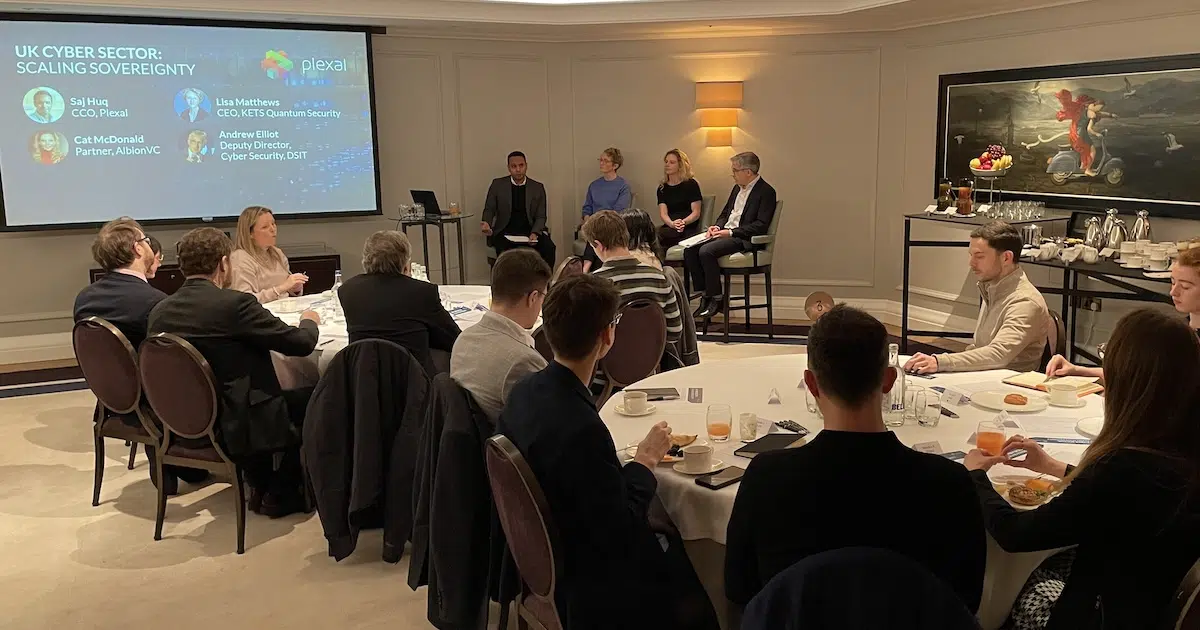
That’s why Plexal recently held a UK Cyber Sector: Scaling Sovereignty event, where we convened the cyber ecosystem and led conversation with influential founders, investors and policymakers – as chaired by our CCO Saj Huq.
Our panellists included:
- Cat McDonald, Partner at technology investor AlbionVC, which backs early-stage companies across cyber security, digital risk and other mission-critical technology sectors.
- Lisa Matthews, CEO of quantum-safe encryption company KETS Quantum, which is in its tenth year of operation having grown from a research spinout
- Andrew Elliot, Deputy Director of Cyber Security at the Department for Science, Innovation and Technology, responsible for cyber skills policy, cyber innovation policy and government regulation of secure consumer connected devices.
Startup sovereignty: A help or hinderance?
The ongoing sovereignty conversation across the innovation ecosystem and its increased priority has brought about the concept of becoming a sovereign company, prompting some businesses to plug this newfound buzzword into their messaging to keep up with what’s seemingly a new expectation.
We debated what makes a sovereign company. Is it just a UK-founded or UK-focused business? If so, does this hamper opportunity – or create a company with a substantive R&D tech and talent base in the UK that pursues global opportunities?
And, given the differing avenues that overseas countries are pursuing for their own sovereignty through technology, does being from the UK help, hinder or not matter?
But it’s a combination of factors. Being a British company, with domestic interests, creating local jobs and boosting UK growth, while seizing overseas opportunities in new markets, this is the foundation for operating as a sovereign enterprise.
This was the case for Bristol-based KETS Quantum, which sits at the intersection of UK security and deeptech, with critical technology in quantum. The business has faced various export controls for international work in markets such as Denmark and Canada – although being UK-founded wasn’t a blocker for success.
What can slow down cyber startups, however, is use of supply chain components from a variety of different geographies – rather than just the UK. This international composition can create additional export control processes and restrictions, potentially delaying an overseas rollout.
This could be the result of legislation varying depending on the market – or indeed if there’s a conflict between the country a startup intends to enter and the home of the technology stack used in its product.
For KETS Quantum, however, its clear development of technology from the UK provided a degree of credibility and their approach meaningfully differentiated it from alternative, international offerings.
Davos: Collective problems need collective solutions
Sovereignty was a centrepiece during the World Economic Forum as global leaders descended upon Davos. It was broadly agreed that while sovereignty is about ensuring national resilience for each nation, it doesn’t mean countries should retreat into themselves but be willing to cooperate where interests align.
Singapore’s President Tharman Shanmugaratnam declared: “Collective problems require collective solutions and everyone has to pitch in with the right burden sharing,” while Bart De Wever, Prime Minister of Belgium, warned: “We either stand together, or we will stand divided.”
For innovators within the UK’s cyber ecosystem, this is the chance to step up and deliver.
“We can’t just do things ourselves,” said Saj. “We can’t build all the best technologies here, nor can we avoid collaboration with international partners or foster the UK’s influence on the global cyber stage in isolation. But driving international business success – and therefore growing UK companies into truly global operations to capture a meaningful share of the global cyber market is very much in the UK’s own, sovereign interests.”
The UK Government: Delivering digital confidence
Released at the start of the year, the Government Cyber Action Plan set out a roadmap to improve cyber security and resilience of the government and public sector. The aim is ensuring online safety of British citizens and securing their confidence in digital developments.
Quite rightly, Ian Murray, Minister of State for Department for Science, Innovation and Technology, stated: “We cannot build a secure future on fragile foundations.”
Delivering programmes such as Cyber Runway and NCSC For Startups to support technical advancements and business growth, we understand the UK Government’s focus on building the UK’s domestic capacity for cyber. Its ambition is to scale cyber as an ecosystem fortified with products, services, innovation and skills that can strengthen our sovereignty with resilience and economic growth.
The Minister of State pointed to a “historical underinvestment” in technology and cyber security, adding “every public sector leader bears direct accountability” to fix vulnerabilities. He noted the plan is “prioritising cyber resilience and ensuring we have strong central leadership driving cross-government response.”
In line with this, our sovereignty debate pointed to the urgency for UK Government to apply our best-in-class technology to critical national infrastructure – something we’re driving through Cyber Runway CNI. This is in conjunction with UK industry adopting best practices to ensure their businesses are resilient with support from sovereign solutions.
Cyber is a foundational domain that enables and secures the broader digital economy. Offering VC insights, Cat highlighted that actively nurturing and developing the UK’s cyber capacity helps not only create great cyber companies directly but supports the resilience of our wider critical industries – public sector, finance, health, advanced manufacturing and defence. As a collective, these industries are the backbone of our nation and their resilience is critical to the UK’s sovereignty.
“The UK Government’s capacity as a buyer of cyber technology from startups and SMEs is massive for driving economic growth,” Saj detailed. “Its commitment to enhance cross-government cyber resilience is a crucial step that can add to the flywheel effect of growing the British economy.”
Moving forward: Driving global outcomes in the UK’s interests
Our conversation found that there’s a risk at play – where the rush to apply narrow or domestic-only objectives in pursuit of sovereignty lack scale and limit overall, international opportunity to make a global impact.
This shouldn’t be the case.
We can achieve sovereign outcomes for the UK alongside securing a global technology leadership position – the two aren’t in conflict with each other.
Like KETS Quantum, there are many companies operating at the intersection between cyber security and critical technologies – and this is the opportunity in our grasp.
This positioning to bridge two technology areas, such as cyber and financial services or cyber and biotech, is particularly attractive to investors. It also helps create bigger market opportunities for innovators, helps drive adoption of technologies in key sectors – and enhances the resilience of areas of our economy in which we have a global leadership position.
The collision of technologies within key verticals can support sovereignty by providing the UK with autonomy, leadership, resilience and economic prosperity – allowing startups to stand out to VCs, compared to those with more generic offerings.
“The UK is capable of achieving leadership in the emerging and critical technology areas,” Saj said, “which we’re already seeing with the work being done in AI security. Cyber security underpins many industries, including those that form critical national infrastructure.
“Sovereignty is categorically not about building everything ourselves or producing UK-only capabilities. It’s about driving outcomes in the UK’s interests and giving the UK the right control and destiny over its own resilience. This means facilitating adoption into areas that are underserved and under threat – particularly within critical national infrastructure – to keep our country safe and prosperous over the long term.”

