As global threats grow more complex, the defence industry continues to invest heavily in the innovations needed to safeguard our future. Both the Strategic Defence Review (SDR) and the Defence Industrial Strategy stress that emerging technologies will define tomorrow’s battlefields – demanding a stronger ecosystem and fresh models of public-private partnership.
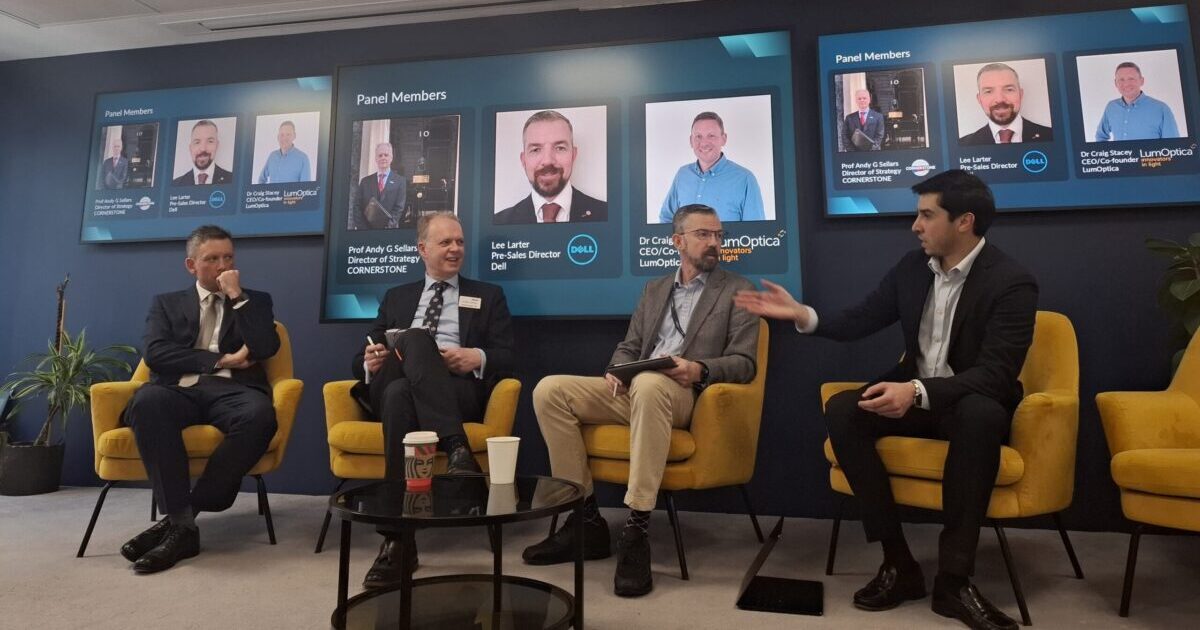
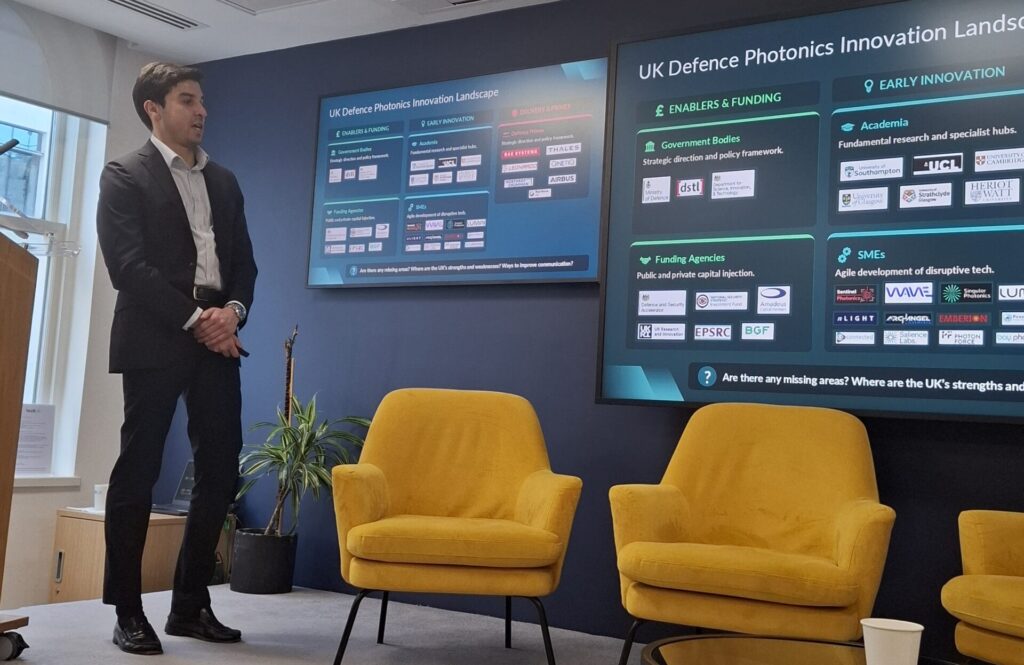
As part of Plexal’s Advanced Hardware for Defence Event Series on Wednesday 26th November, a group of key defence and photonics industry figures met at techUK’s London offices to discuss the emerging technology and highlight the opportunities and barriers facing the UK photonics sector.
Photonics, the science and technology of light is essential in modern defence because it enables the development of systems that offer unparalleled speed, accuracy, security and efficiency compared to traditional electronic and radio-frequency (RF) technology.
At the heart of next-generation defence capability, photonics promises to enable everything from high-speed secure communications to advanced sensing and imaging. As the UK delivers on the ambitions set out in the Defence and Security Industrial Strategy, events like this are critical for bringing together government, industry, academia and startups to accelerate innovation fostering communication, ideation and ensuring that research transitions rapidly into deployable capability.
Plexal’s Dr Daniel Burt, was joined in conversation by Lee Larter, Dell’s UK Pre-Sales Director, Professor Andy Sellars, CORNERSTONE ‘s Director of Strategy, and Dr Craig Stacey, LumOptica’s CEO. Our key takeaways from the dynamic conversation are as follows:
Photonics is rapidly becoming foundational to modern defence capability
It now drives advantage in sensing, communications and computing for electronic warfare, with speed-of-light systems increasingly determining operational superiority.
The UK benefits from a uniquely rich and interconnected photonics ecosystem
Government bodies, primes, universities and high-growth SMEs create a pipeline that can move ideas from lab to deployment faster than many international competitors. However, there are still challenges with interconnectivity and scope for closer collaboration between industry players.
Operational requirements promote a shift towards smaller, lighter and more robust optical systems
Achieving these size, weight, powers and cost demands will rely heavily on integrated photonic chips to deliver performance that can survive harsh real-world environments. This presents an opportunity for further innovation in this sector, leveraging excellent UK heritage and abilities.
Dual-use markets are accelerating defence photonics
The defence industry can capitalise on the fact that photonics is taking off in other sectors. Massive civil investment in LiDAR, AR/VR, medical imaging and data-centre optics will drive down cost and risk. This will offer defence a faster route to adoption, as well as wider benefits to society through the implementation of photonics technology.
The UK has a chance to capitalise on this opportunity to secure its long-term position in photonics
Strengthening supply chains, improving collaboration between key players, developing talent and backing emerging niches such as quantum dots, single photon sensors or photonic integrated circuits. Taking advantage of the opportunities presented can help the UK cement its position as a leader in this sector.
With special thanks to Dell Technologies and Intel for sponsoring the event, as well as techUK for hosting.
This conversation was part of Plexal’s “Advanced Hardware Series” with further events on the topics of semiconductors and quantum computing to follow in 2026.
Are you interested in engaging the advanced hardware ecosystem or Plexal’s expert research capabilities? Please reach out to us.